

Cairo Egypt Islamic Coin Abbasid Gold Dinar Harun Al-Rashid 181 AH Citing Ja'far
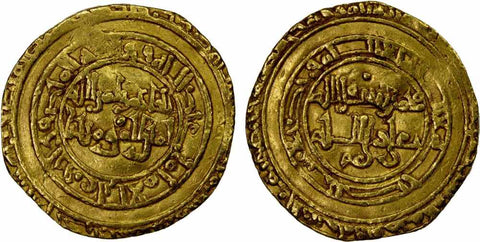
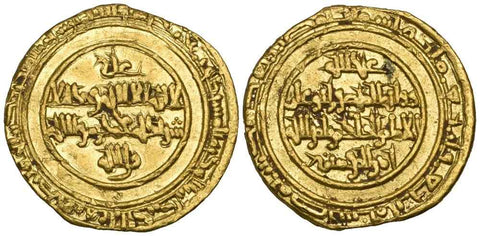
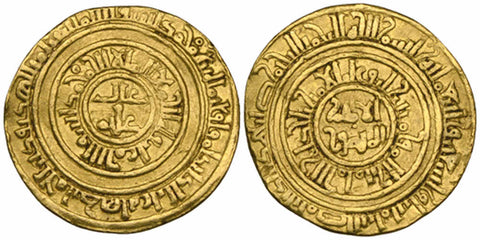
Description: Gold dinar from the time of Harun Al-Rashid of 1001 Arabian Nights fame. Al-Rashid ruled the Muslim empire in the period 170-193 AH (786 - 809 AD). Al-Rashid is the fifth caliph of the Abbasid dynasty. His full name being Abu-Ja'far Harun al-Rashid. This coin cites Ja'far, who according to al-Ush may have been the ceremonial governor of Egypt in the period 176-187 AH. The coin weighs 4.19 grams and measures ~18 mm. A definite beautiful coin of the highest quality. Please carefully review the photos presented as they are part and parcel of our description.
Date: the coin is dated 181 AH or 797 AD.
Mint: Although the mint is not shown on the coin, it is known to have been minted in Misr (current day Fustat on the outskirts of Cairo the current capital of Egypt). Note: As is the norm with these coins, it does not show where it was minted and it is anonymous and does not indicate the name of the ruler. Instead, the coin has religious inscriptions and indication that Mohammed is God's messenger. It also has the name "Ja'far" on the reverse, indicating that it was struck in Egypt.
Size and weight: This is a dinar, weighs 4.19 grams and is ~18 mm in diameter.
References: It is Album #218.11 and it is listed in Al Ush's book “Arab Islamic Coins Preserved in the National Museum of Qatar” as 1094. The coin is listed in Lane Poole's Catalog of the Khedivial Collection as numbers 418.
Condition: I would grade the coin as a nice very fine to about extremely fine with nice and very readable calligraphy and light toning. It is beautiful and problem free with minor wear commensurate with its age and circulated state. This is a great looking quality coin worthy of a spot in your collection. Please see scans for additional condition information.
Historic Perspective: Abbasid is an Arabic ruling dynasty, originally based in Madinat al-Salam (current day Baghdad) that expanded the Muslim empire and lasted from 750 Ad to 1258 AD. It was named for al-Abbas (566?-652), paternal uncle of the prophet Muhammad. During the first century of the Abbasid rule the empire experienced a time of unprecedented cultural, artistic and economic development, particularly during the reigns of Harun al-Rashid (786-809) and his son al-Mamun (813-833).<p>Al-Rashid, the fifth of the 37 caliphs of that dynasty reigned for 23 years. Under al-Rashid's rule, Baghdad became "a Paris of the ninth century,” with an ever-growing population, merchants, eunuchs, physicians, philosophers, poets, storytellers, mathematicians, in short, all sorts of people. In addition, al-Rashid built schools, libraries, hospitals, and supported the translation of many Greek and Latin texts into Arabic. Harun al'Rashid reportedly encouraged literature and learning and brought learned men from all parts of the empire to Baghdad. Al-Rashid also corresponded with Charlemagne and even sent him a clock and an elephant. Yet despite the advances promoted by al-Rashid, historians never mention his cold and despotic rule. For the slightest reason, he could (and did) have anyone he wished executed and even kept an executioner with a drawn sword by his throne at all times! His own viziers provide an unhappy example of al'Rashid's absolute power. He is assumed to be the king described in the fabled stories of One Thousand and One Nights.<p>Although Harun al'Rashid ruled during the Golden Age of Arabia, after and indeed during his rule the empire began to disintegrate, despite the advances he had promoted in medicine and education. Actually, this disintegration resulted from the decadent lifestyle led by the caliph, his court, and many of his subjects as well as the corruption among the governors he appointed to rule provinces of the Arab empire. Decadence found in daily life included polygamy and the taking of concubines in addition to slavery and harsh treatment of subordinates.